News NewsSitemap SitemapContact Us Contact Us
  • Deutsch
Home arrow FIIT's Departments
FIIT's Departments PDF Print E-mail
Comprising a third of humanity, Christianity is among the most influential cultural  factors worldwide.  Moreover, it is growing at a fast rate in Asia, Africa, and Latin America.  Thus it is hardly possible to understand current developments without taking into account how Christianity shapes peoples' lives - worldwide, but also in Europe and Germany.
FIIT sees its particular task in reflecting on global developments theologically and making Christianity's potential in providing orientation accessible also to non-theological academic disciplines.
FIIT's twelve departments work on research projects in the areas of anthropology and ethics, Biblical studies and global developments as well as religion, culture, and education.
 

I.    Theology in Dialogue with the Natural and Cultural Sciences

FIIT's department I explores crucial theological and societal issues in dialog with  the natural and cultural sciences.  Led by the executive director of FIIT, Prof. Michael Welker, this branch annually organizes four international and interdisciplinary conferences, which are part of a five year research agenda.
 
These projects involve theologians, legal experts, economists, philosophers, historians, physicists, chemists, and biologists. Under the title "Flesh – Body – Mind – Soul – Spirit: The Complex Unity of the Human Person," scholars work on substantive concepts of the human person,.  Another project discusses "Concepts of Law in the Sciences, Legal Studies and Theology."  In further projects, researchers explore "Concepts and Practices of Freedom in the Biblical Traditions and Contemporary Contexts" and examine "The Standardized Monetarization of the Market and the Impact on Religion, Politics, Law and Ethics."  Cooperation in individual groups, which include 20-25 scholars from Europe, North America, Asia, and Africa, is laid out for five years, supported by third party funds provided by various supporters.

 
II.   Theology, Bioethics and Medical Law (Human Dignity)

In medical and legal practice the concept of human dignity raises complex questions, which call for further clarification also in theology, philosophy and other disciplines in the humanities and human sciences.

Via department II, which is headed by Professors Thomas Fuchs (Medicine), Wilfried Härle, and Klaus Tanner (both in theological ethics), FIIT is connected to the Interdisciplinary Forum for Biomedicine and Cultural Sciences ("Interdisziplinäres Forum für Biomedizin und Kulturwissenschaften," IFBK) of Heidelberg University.  In the project "human dignity" at IFBK, representatives of ten disciplines discuss questions of principle, content, and application.  In December 2007, the forum hosted a symposion on "the foundations of human dignity and human rights."

Moreover, with funds provided by the Robert Bosch foundation, the department organizes a project involving high school students.  Cooperating with scholars of Heidelberg University, four high schools in Heidelberg, Mannheim, and Karlsruhe offer annual one year courses dealing with human dignity.  The first course, launched in summer 2006, dealt with the subject "living a dignified life until the end," while the following year students focused on "human dignity at the beginning of life." The current classes (2008-2009) are devoted to the relation between "human dignity and violence."


III. Pastoral Care, Psychology, Medicine
 
Prof. Wolfgang Drechsel (Practical Theology) and Prof. Dr. Hubert Bardenheuer (medicine: palliative care) coordinate department XI.  In cooperation with the newly founded Center for Pastoral Care Heidelberg of the Protestant Church in Baden, new perspectives in interdisciplinary cooperation (medicine, theology, psychology) are further developed for research in pastoral care and concrete application.
 
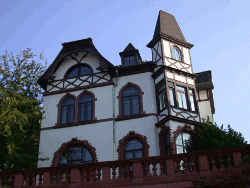
The Center for Pastoral Care Heidelberg, which is located in FIIT's building in Hauptstr. 240, offers a forum that initiates academic research on the practice of pastoral care and its conditions, but also reflects on the conditions and possibilities of poimenic research itself.  The center participates in the education in pastoral care both for present and future pastors as well as for volunteers.


IV.   Theology and Archeology

We can find traces of Israel's history not only in written sources.  Modern archeology contributes significantly to the understanding of the Biblical world.  Department V, led by Professors Peter Lampe, Manfred Oeming, Jan Christian Gertz, and Reinhard Stupperich, carries out regular archeological digs in Phrygia (Turkey) and Ramat Rahel (Israel).

The project in settlement archeology conducted by Prof. Peter Lampe in Phrygia  discovered the two Montanist cities Pepouza and Tymion.  Researchers had been looking for the sites since the 19th century.  The first results have been published in the volume Pepouza and Tymion: The Discovery and Archaeological Exploration of a Lost Ancient City and an Imperial Estate (Berlin/New York: deGruyter, 2008, in German, English, Turkish).  Presently the geographic radius of the project is expanded to 35 km to include all potential Montanist settlements in the area.

The archeological dig in Ramat Rahel, carried out by Prof. Manfred Oeming in cooperation with Tel Aviv University, attracted attention with the discovery of coins from Second Temple times.  Once destined for use in the temple, the coins were hidden by Jewish believers fleeing from the Romans in Ramat Rahel.  Already in 2007, Israel's first garden site, dating from the iron age, and a complex system of water supplies, including a system of pools, were unearthed.  The discovery of a Muslim structure from the 8th-11th centuries CE also stands out.  About 60 students from Heidelberg helped unearth the finds, contributing to the success of the project.

Prof. Jan Christian Gertz heads a research project funded by the "Deutsche Forschungsgemeinschaft" (German Research Foundation) that explores the locations mentioned in the book of Deuteronomy.  Focusing on the frame chapters of the book (Dtn 1-11; 27-34), which still betray the history of redaction, the project hopes to find hints at the genesis of the writing  that are warranted by historical research.  Specialized studies are devoted to the locations mentioned in Dtn 1 and the few place names in Dtn 12-26.  The endeavor also aims at clarifying little pondered methodical questions concerning the constructive connection between exegetical and archeological work in Biblical topography. As part of this project, an international and interdisciplinary symposion was held at the "Internationales Wissenschaftsforum Heidelberg" called "The Description of Places: From Antiquity to Modern Times" (June 2008).


V.  The Cultural Power of the Bible and the Christian-Jewish Dialogue

Biblical traditions continue to influence current societal and cultural developments.  Under the leadership of Professors Hanna Liss (College for Jewish Studies, Heidelberg) and Manfred Oeming, department VI deals with the abiding influence of Jewish and Christian traditions.
In the project "'Wirkungsgeschichte' of the Psalms," Dr. A. Wagner and Dr. J. Vette collaborate in creating a database that includes all musical, literary, and pictorial settings of the Psalms as well as sermons, aiming at a more thorough academic analysis.
 
Moreover, at the chair of New Testament scholar Peter Lampe an archive on the "Wirkungsgeschichte" of the Letter to the Romans is compiled that is unique in documenting the history of reception and influence in western political philosophy and history as well as church history.  The findings will be made available online.

An empirical exploration by Prof. Helmut Schwier assesses the immediate impact of biblical interpretation.  By help of the "reactoscope procedure," people record their reactions while listening to a sermon (S. Gall/H. Schwier, Predigt hören: Befunde und Ergebnisse der Heidelberger Umfrage zur Predigtrezeption, 2008).
 
Further, department VI coordinates the cooperation between FIIT and the Heidelberg College for Jewish studies (Heidelberg).


VI.  The Theological Anthropology and Ethics of Early Christianity

Headed by Prof. Gerd Theißen, department IV explores the psychology of early Christianity as well as early Christian ethics in their development and current potential for orientation.  This research project generated numerous publications: The volume Recognition and Experience: Contributions to the psychological exploration of early Christianity (German) documents a 2006 conference.  The following year Prof. Theißen published the book Experience and Behavior of the First Christians: A Psychology of Early Christianity, which was translated into seven languages the same year.


VII. Monastries in the High Middle Ages

The project of the Heidelberg Academy of the Sciences, "Monastries in the High Middle Ages: European Laboratories of Innovation in Concepts of Life and Models of Order," analyzes how the monastic world of the Middle Ages paved the way for modernity. Within the social and religious change from the 11th to the 13th century, monastries developed a mode of life that had so far been unparalleled for its rationality. The new developments in society and culture arising in those days led to particular constellations of order in European modernity.

Two closely interconnected centers of academic research, located at the Heidelberg and the Saxonian Academy of Sciences respectively, are devoted to these reserach goals. The research areas of the partial projects complement each other mutually. While the Dresden team deals with concepts of order and life within monastries, research in Heidelberg focuses on texts that provide meaning by interpreting the world as well as on exemplary manuals of order. The project is headed by Dr. Bernd Schneidmüller and Dr. Stefan Weinfurter.


VIII. Theology and Legal Studies

Connections between justice, mercy, and the quest for truth displayed in the Old Testament/Hebrew Bible influenced concepts as the rule of law and the welfare state.   The Reformation in particular set the course as it drew on Biblical traditions and thus shaped modern legal developments.

Department IX explores the relationship between theology and justice in antiquity, Biblical traditions and modernity.  With the professors Jan Christian Gertz, Christian Hattenhauer, Ute Mager, Christoph Strohm, Klaus Tanner, and Michael Welker, the department is led by scholars from legal studies and theology.  Moreover the branch cooperates with the Center for the Study of Law and Religion (Emory University, Atlanta).

Christoph Strohm recently presented results of his research on early modern history in a comprehensive monograph: Calvinism and Justice: The factors of worldview and denomination in the works of reformed jurists in early modernity (German, 2008).


IX.  Religion in Educational Development

Department VIII directs its attention to the interdependency of religion and education.  This branch of FIIT is coordinated by the Professors Ingrid Schoberth,  Silke Leopold and Daniel Krochmalnik (College for Jewish Studies Heidelberg).  The project "Theology for children" is at the center of attention, which also involves cooperation with department I and the University of Valparaiso (U.S.A.).  Moreover, in cooperation with German protestant mainline churches, a study based on empirical research investigates the extent and quality of church programs for children and youths.  All in all the projects aim at the development of applicable modules for sophisticated contemporary religious education.


X. Religion in the United States
 
Department XII is headed by Prof. Jan Stievermann (American Studies/American Church History).
 
 
XI. Potentials of Denominational Differentiation
 
The denominational differentiation within Christianity is not solely a matter of concern - we should also explore the positive options it offers.  This is the basic idea that governs the work in department X.  Led by Prof. Friederike Nüssel the branch examines the correlation between confessional differentiation and interdenominational contacts on the one hand and societal developments and processes of ethical  decisions on the other.
 
Denominational differences in the interpretation of the Christian faith not only influence the ecumenical relations between the churches, but also their response in various societies as they react to challenges in politics, academics, worldviews and education.  In cooperation with theologians of different denominations as well as sociologists, the department contributes to a more precise description of denominational differentiation in such processes. For these tasks the guiding question is in how far denominational/confessional differentiation can be understood as a resource in responding both critically and constructively to the challenges of pluralistic societies.
 
In close connection to this approach in research the Ecumenical Institute at Heidelberg University hosts an "Ecumenical Forum" every semester.  On the occasion of the 50th anniversary of the Ecumenical Institute and Dormitory (winter term 2007/2008), Karl Cardinal Lehmann and Archbishop Jeremiasz (Poland) gave lectures on the history of the ecumenical movement  and current ecumenics.  In summer 2008 professors Konstantin Delikostantis and Marios Begsos of Athens University gave presentations on the subject "Christian Freedom from the Perspective of Orthodox Theology."  In the following winter term the Ecumenical Forum focused on "Theology in Latin America."  Among others, Prof. Dr. René Krüger from Buenos Aires gave a presentation.


XII. Religious Studies and Intercultural Theology

In association with the European Research Network on Global Pentecostalism and the universities of Amsterdam and Birmingham, department III explores the rapid growth of the worldwide pentecostal movement.  The department is led by Professors Michael Bergunder and Gregor Ahn.  Research on the importance of pentecostalism among migrants shows that such growth also changes the situation in German churches and society.  The research project "Nigerian Pentecostal Churches, Networks and Believers in Three Northern Countries" is supported by the European Union.
Department III also maintains the multi-user online platforms for IAKP and GloPent.  The performance of these research tools has been greatly enhanced during the past two years.
 

XIII. Theological Diaconal Studies and Sociological Research

Department VII focuses on the social consequences of the current societal change.  The branch is led by Professors Andreas Kruse (Director of  the Institute for Gerontology Heidelberg), Heinz Schmidt, and Johannes Eurich (Director of the Institute for Diaconcical Studies Heidelberg).  In several projects they combine methods and perspectives in diaconical and social studies.
 
The topics education and aging are the focus of research.   The anthology Education as a diaconical task: Empowerment - Participation - Justice (German; ed. H. Beck/H. Schmidt, 2008) documents a 2007 Heidelberg conference on education that met with a resounding response in the academy and the media.  Further, the department is not only interested in producing research results relevant to society, but also in communicating them to a wider public - as a volume on aging from 2007 shows: '...like Climbing on a Mountain.' Age and Aging in Society (German; including a workbook and a teacher's edition).
 
Moreover the department initiated a European Masters-program that involves FIIT's coperation with universities in Norway, Finland, Estonia, Sweden, and the Chech Republic.
 
© 2013 FIIT-Forschungszentrum Internationale und Interdisziplinäre Theologie - Research Center for International Interdisciplinary Theology